Mom hasn't recognized me in two years. She sang my name yesterday.”
Margaret Chen
Daughter · Sunrise Memory Gardens, Portland, OR
200+
Families Served
14
Partner Facilities
8 yrs
In Practice

Music memory is the last to fade
Neurological research, Journal of Music Therapy
Will she even understand what's happening?
She doesn't need to. That's what makes music therapy different from every other intervention you've tried.
Musical memory lives in a different region of the brain than language, recognition, or episodic memory. When dementia erases names and faces, the songs from a person's twenties — the ones played at their wedding, hummed while washing dishes, heard on Sunday radio — remain largely intact. A trained therapist knows how to find those songs and use them as a doorway.
✦ “Procedural and implicit memory for music is preserved even in advanced Alzheimer's disease.”
— Jacobsen et al., Journal of Music Therapy, 2015
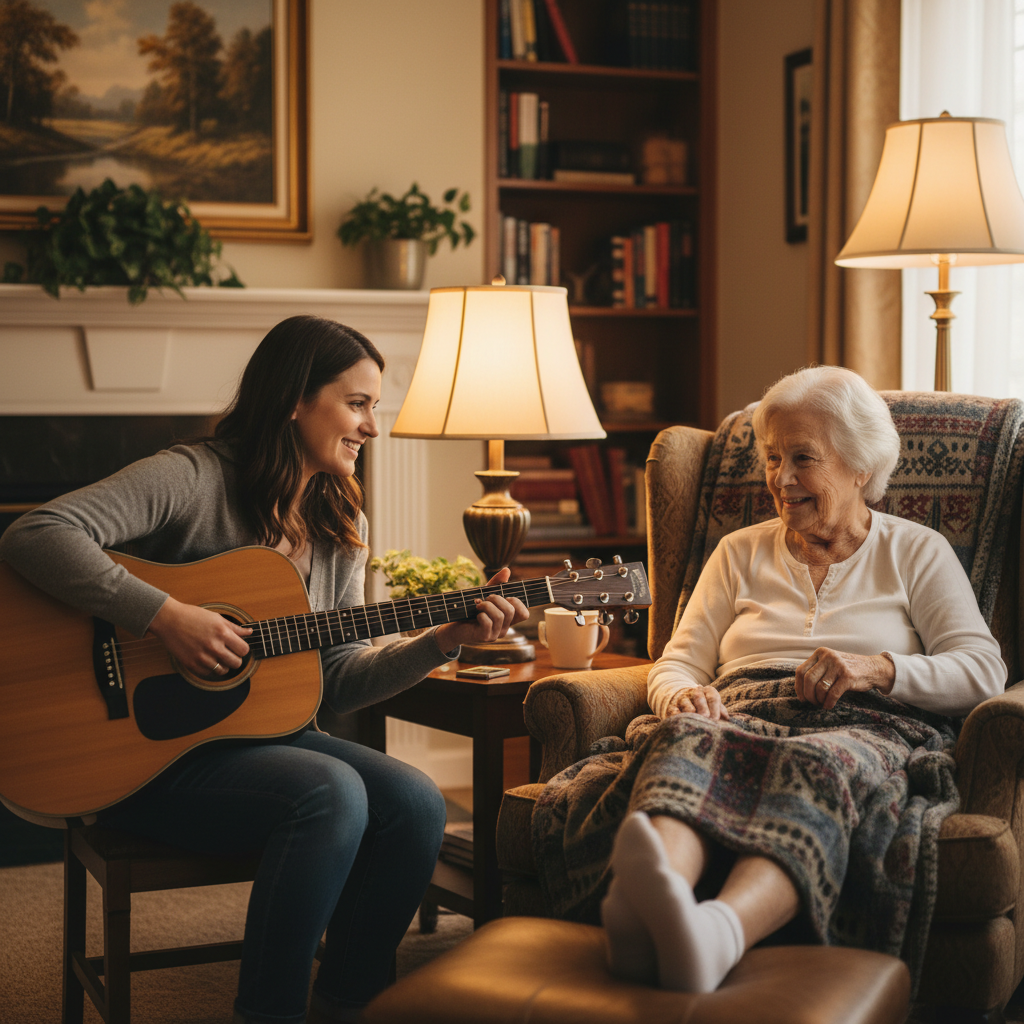
No preparation needed from your loved one.
Sessions are led entirely by the therapist — residents just receive.
Medicare Part B
Covered when prescribed by a physician as part of a documented care plan. Harmony handles all prior authorization paperwork.
Medicaid (most states)
Covered under HCBS waiver programs in 38 states. We verify eligibility before the first session.
Hospice Benefit
Music therapy is an explicitly covered service under the Medicare Hospice Benefit as a component of palliation.
Private Pay
$85–$120 per session. Sliding scale available for families with documented financial hardship.
✦ “Music therapy is among the most cost-effective non-pharmacological interventions for behavioral symptoms of dementia.”
— Cochrane Review, Music-based Interventions for Dementia, 2023
Does Medicare cover this?
Yes — and more often than most families realize. Music therapy is a reimbursable service under Medicare Part B, Medicaid waiver programs, and the Medicare Hospice Benefit. The key is having it prescribed as part of a documented care plan, which Harmony helps coordinate from day one.
We handle the paperwork. You just tell us about your mother.
When Words Fade, Music Stays
A Family Introduction to Senior Music Therapy
A 12-page guide written for the adult child who is up at midnight searching for something — anything — that might reach their parent. Plain language. No jargon. Real answers.
How music therapy differs from music as background
What a first session looks like, step by step
Questions to ask your parent's facility
How to request a referral from their physician
Signs that music therapy is working
Download the Family Guide
Free. No sales calls. Just the information you need.
We don't share your information. Ever.
What if he gets agitated?
This is the question every family asks — and it's the right one. A trained music therapist isn't a performer dropping in to entertain. She is a clinician who has spent years learning how to read a room, de-escalate tension, and follow a resident's lead.
We meet him where he is.
If a resident is agitated when the therapist arrives, the session adapts. Sometimes that means sitting quietly at first, letting the music fill the room without asking anything in return. Participation is never forced.
The music itself is calming.
Research consistently shows that live music reduces cortisol levels and behavioral agitation in dementia patients. The therapist's presence — a real person, a real instrument — is qualitatively different from a playlist.
We coordinate with the care team.
Before any session, Harmony therapists review behavioral notes and speak with nursing staff. We know about sundowning patterns, medication schedules, and what typically triggers distress.

“He was pacing and wouldn't sit down. She started playing softly from across the room. Within two minutes he was in the chair next to her, eyes closed.”
— Priya Mehta · Activity Director, Ashwood Gardens
See if your facility qualifies for Harmony.
Harmony works with memory care units, assisted living communities, and hospice programs. We operate on a per-session or monthly program basis, fully integrated with your existing care team and documentation systems.
Documented outcomes
Every session generates a clinical note compatible with your EMR system.
Flexible scheduling
Weekly, bi-weekly, or as-needed. Individual sessions and small group formats.
Staff education
1-hour CE-eligible in-service training for nursing and activity staff included.
Regulatory documentation
Supports compliance with CMS requirements for non-pharmacological interventions.
Facility Intake
Takes 90 seconds. We'll follow up with a program overview matched to your census.
The guide is free. The questions don't have to wait.
Download When Words Fade, Music Stays and bring it to your next conversation with the care team.
No spam. No sales calls. You can unsubscribe at any time.